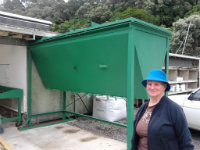
SOSSI and Tuesday volunteers have completed a major upgrade of the Sossi nursery, with financial support from Auckland Council and Pub Charity.
New hopperThis has created a more efficient production unit for pricking out and bagging on new young seedlings as they arrive from the Botanic Gardens who are doing the seed propagation work for us. A new hopper has been constructed to feed potting mix directly onto the work table, saving time and reducing the back stress on volunteers. This work area is also now covered by a retractable canopy to protect from rain and sun. Nursery shadehouse A shade cloth covering for the “old nursery” area has also been built. This will give the newly bagged seedlings an initial good growing environment to settle down prior to being moved to the new standing out area where they will grow on until planting days next autumn.
We have committed to producing around 10,000 plants every year for re-vegetation planting so there is lots of work to be done, and new volunteers would be most welcome to help.
Now that whiteheads have been successfully re-introduced to Shakespear the next step is to bring back the North Island robin (toutouwai). These are very sociable little fellows, often to be seen foraging just a few meters away. They are also known to sing loud and long so we expect they will be a popular attraction….
Since the formation of the Park in 1975, annual planting has greatly extended the original areas of native bush. Steeper gully areas have been fenced off and the current planting plan aims to fill gradually these. Public plantings for 2016 are on the mornings of June 12, Jun 19 and July 17. These are all…
While some types of ginger can look nice in your garden you’ll regret having any of the ‘wild’ gingers. Yellow ginger and kahili ginger were both introduced as garden plants but they quickly form dense and impenetrable mats of rhizomes which smother anything else. In the wild these can grow to a metre deep and…
This month’s pest plant is Woolly Nightshade, also known as tobacco plant or flannel plant because its leaves have a velvety texture . It has dense clusters of purple flowers, green or yellow berries about 1cm in size and oval, grey-green leaves. It is a major problem because its seeds are spread by birds, it colonises readily and it…
There are some gregarious new residents at Shakespear Regional Park! While other birds have repopulated the area naturally since pests were removed, recent events saw the first release of native birds behind the predator-proof fence. In July 2015, after many months of behind-the scenes work, a group of bird translocation experts and experienced volunteers caught…
This month’s pest plant is boneseed, also known as salt bush. Originally brought in as an ornamental from South Africa, it proved to be a pest (surprise!) because it readily colonises dry areas and soon prevents anything else from growing. This poses a threat to our coastal vegetation. Young plants have soft pale green leaves,…