Shakespear Bellbirds
By Michell Roper
Massey University researchers (including Prof. Dianne Brunton and PhD student Michelle Roper) are monitoring the New Zealand bellbird (Anthornis melanura) population at Shakespear Regional Park to look at their natural dispersal back into the park and as part of a wider study on song development and dialects. Bellbirds occur on various islands throughout the Hauraki Gulf and surrounding mainland sites such as the Coromandel peninsula, Shakespear and Tawharanui Regional Parks.

Bellbirds have regional dialects and this includes between the islands of the Hauraki Gulf. By looking at their dialect, we can detect where new and existing bellbirds at Shakespear may have come from. The founding bellbird population (approx. 100 birds) at Tawharanui arrived from Little Barrier Island shortly after the predator fence was up and running. However, bellbirds do not seem to have arrived at Shakespear in such great numbers. For the last 2 seasons, Michelle Roper has been intensely banding juvenile bellbirds on Tiritiri Matangi Island. With the good breading season the bellbirds had in 2013, perhaps we will find more bellbirds arriving at Shakespear, but more surveys at Shakespear are needed to examine this. During our surveys this past breeding season, two breeding pairs and at least three fledged chicks were found within the park. On our recent visits, a female banded by Michelle on Tiritiri Matangi Island last year was found in Kowhai Glen and other bellbirds were heard and seen nearby and in Waterfall Gully.
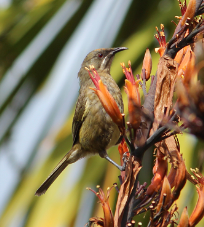
For Shakespear bellbirds we will look at where they have come from and how quickly their dialects change. This information will contribute to further research on understanding the development of their song and song function. Both sexes sing and each sing different types of songs leading to questions about whether song development and dialect changes are the same for both sexes.
To help with monitoring and finding bellbirds at Shakespear to record their song, support from regular volunteers and visitors would be much appreciated. We would like to receive information on any sightings of bellbirds (location within the park, sex and age, time and date, and behaviour – food eaten, singing, interactions with other birds etc). In the spring and summer, any sightings of females carrying nesting material, or males or females feeding chicks would be very useful.
Most importantly, if you see a bellbird with colour bands on its legs, it would be great if you can let us know and even better if you can identify the colour band combination (colour bands are read: birds left and right – top left, bottom left, top right, bottom right e.g. RW-GM has red over white on the left leg and green over metal on the right leg). These can be reported to SOSSI or direct to us at bellbirdsongNZ@gmail.com.