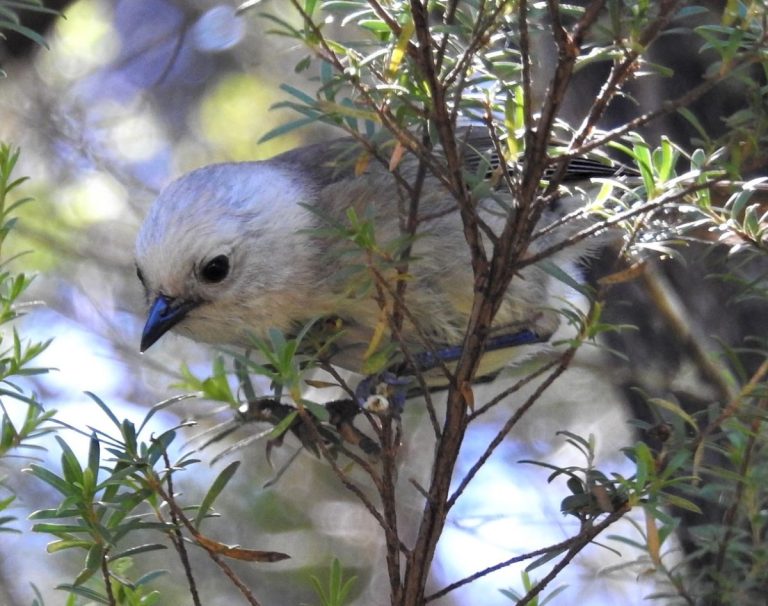
Robins update
In April last year 40 North Island robins (toutouwai) were re-introduced to Shakespear. Thirteen pairs established and have now completed their first breeding season with 34 chicks being raised.
Kowhai Glen was the most productive area, producing 11 young. For some unknown reason the pairs in the apparently good habitat on the Defence Force land did not produce well. Conversely our best producing pair, with 6 young, was living in a re-vegetation area of mainly kanuka/manuka. You really can’t second-guess birds.
The progress of these young birds has been monitored by SOSSI members Richard Chambers and Maree Johnston. Although it is time consuming to check the birds each week, robins are such friendly and easy birds to work with that it’s also very rewarding.
Nesting takes place between September and January and during that time nests were monitored and most of the young were banded while still in the nest. Banding allows us to keep track of their movements and history. People often say to us “I’ve just seen OB-OM at the Waterfall Gully seat” for example, which is very helpful. The banding has to be done in a narrow time-frame of a week or so when chicks are big enough to band but not big enough to flee.
SOSSI member Ian Miller made a short film of the nesting and banding of robins which you can see on youtube.
Already we know some of this year’s juveniles have paired up or settled in the Open Sanctuary, so there’s a good chance they’ll be around for next year’s breeding season. Despite this there are a lot of young robins that haven’t been seen since they left the nest. These juveniles can travel great distances in search of a mate and a place to settle down, even along the Peninsula outside the park.
This is the kind of ‘spillover’ of birds from the park that will happen more and more as bird numbers inside the fence increase. Their chances of survival outside the park are not great, largely due to rat predation, but as Forest and Bird’s Pest Free Peninsula project gains traction life for birds in peninsula gardens will improve.
Along with whiteheads released at Shakespear Park in 2015, robin chicks are the only birds locally with colour bands on their legs so keep an eye out for them anywhere along Whangaparaoa Peninsula, but particularly nearer the park. If you see a banded bird please send us a message on facebook or email – we’d love to know where these birds end up.